
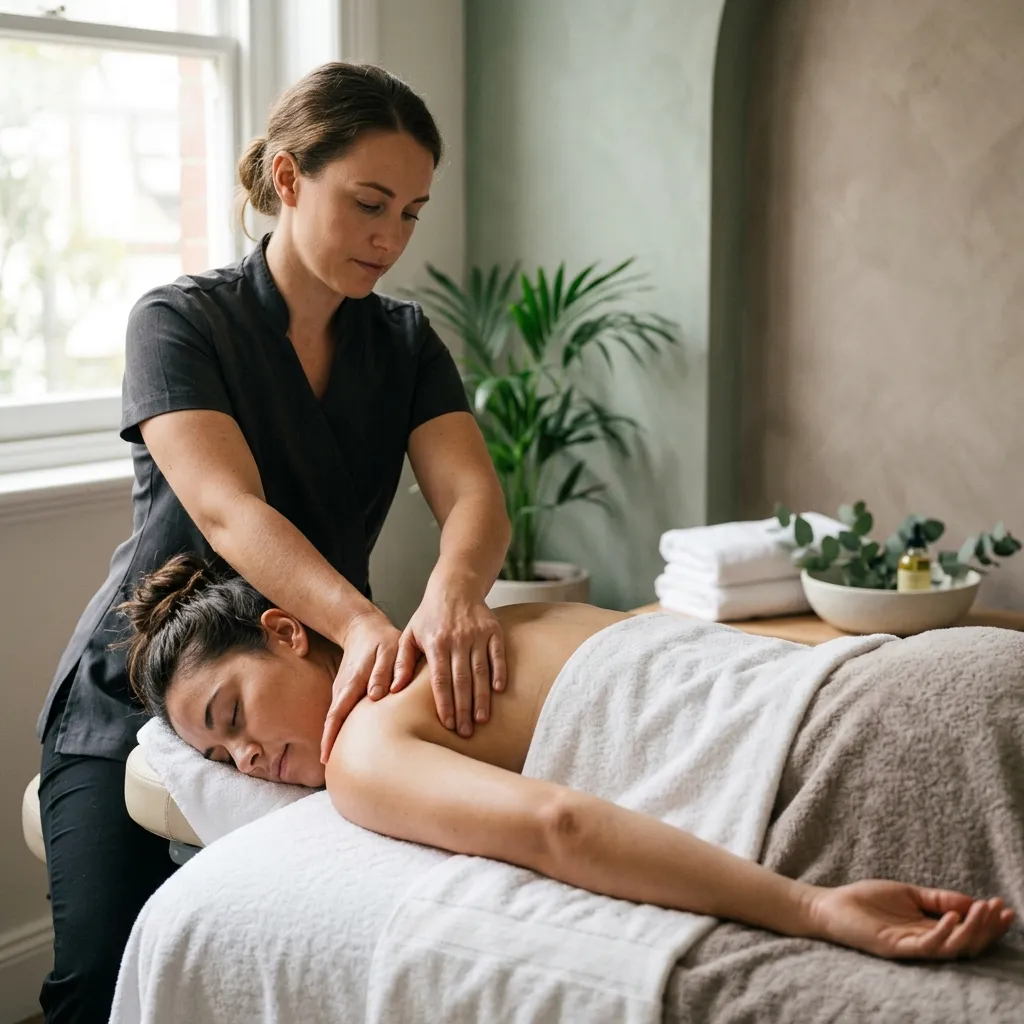
Back problems are more common than most people realise. In 2022, about 4.0 million Australians (16%) were living with them, and they were the leading cause of disease burden for people aged 35 to 54 (AIHW). That’s squarely the desk-bound, active, time-poor crowd we see every week in the CBD. So when you’re finally ready to book something, one question tends to stall the whole thing: remedial massage vs deep tissue, which one do you actually need?
It’s a fair question, and the honest answer surprises people. These two aren’t really competitors. Below, we’ll explain what each one is, where they overlap, and how to pick the right session for your body.
Key Takeaways
- Deep tissue is a technique (firm, focused pressure); remedial massage is an assessment-led treatment that may use deep tissue among other methods.
- healthdirect lists deep tissue as one of the techniques within remedial massage, so you rarely have to choose one over the other.
- For a known injury or ongoing pain, book remedial; for general tension and firmer pressure, deep tissue fits inside a remedial session.
- Remedial massage from a recognised therapist is commonly claimable on private health extras cover.
What is remedial massage?
Remedial massage is an assessment-led treatment, not a single stroke or style. It aims to locate and treat the problem, then manage the pain and discomfort that come with it (healthdirect). In other words, our therapists work out what’s going on before deciding how to treat it.
The peak-body definition is worth knowing too. The Australian Traditional Medicine Society describes remedial massage as the “systematic assessment and treatment of the muscles, tendons, ligaments and connective tissues” to assist rehabilitation and manage pain or injury (ATMS). Assessment comes first, treatment follows.
There’s a training standard behind that word, as well. Remedial massage is a nationally recognised qualification in Australia, the HLT52021 Diploma of Remedial Massage, which includes at least 200 supervised clinical hours and trains therapists to work with soft-tissue dysfunction, musculoskeletal imbalance and restricted range of motion (training.gov.au). When you book our remedial massage in Sydney CBD, that diploma-level assessment is the part you’re paying for.
What is deep tissue massage?
Deep tissue is a technique, a firm-pressure style that works into the deeper layers of muscle and connective tissue. It’s one of the recognised types of remedial massage, listed by healthdirect alongside trigger point therapy and myofascial therapy (healthdirect). So it’s a tool, not a treatment plan on its own.
Here’s the part people miss. “Deep tissue” isn’t a separate regulated qualification in Australia the way remedial massage is. There’s no standalone national diploma called deep tissue massage on the government’s training register (training.gov.au). What you’re really booking is a therapist who can apply firm, focused pressure well, ideally one trained to assess when that pressure is the right call.
Firmer isn’t automatically better, either. Deeper pressure suits some presentations and not others, which is exactly why assessment matters.
Remedial massage vs deep tissue massage: the real difference
The real difference is simple once you see it: remedial massage is the what and why, deep tissue is one of the hows. Remedial starts by assessing the underlying cause; deep tissue is a pressure style a therapist may reach for during that treatment. You’re not usually choosing between them so much as getting the right pressure for your goal.
Here’s the contrast at a glance:
| Remedial massage | Deep tissue massage | |
|---|---|---|
| What it is | An assessment-led treatment that finds and treats the underlying cause | A firm-pressure technique, one style among many |
| Training | Nationally recognised diploma (HLT52021) | Not a separate regulated qualification in Australia |
| Techniques used | May combine deep tissue, trigger point, myofascial and more | Usually delivered within a remedial or sports session |
| Best suited to | A known injury or ongoing pain you want assessed | Specific, firm-pressure goals your therapist identifies |
| Private health | Commonly claimable on extras cover | Claimable only as part of a remedial service |
At MBS, deep tissue work is simply part of our remedial and sports massage. Our therapists tailor the pressure to what your body needs on the day, so the two blend rather than compete.
Which one should you book?
Book by your goal, not by the label. If you’ve got a known injury or ongoing pain, go with remedial so our qualified therapists can assess the underlying cause before treating it. If you just want firmer, general-tension relief, that deep tissue pressure fits naturally inside a remedial session anyway.
Think about what’s actually bothering you. Persistent non-specific lower back pain from long hours at a desk? That’s an assessment job, so remedial is the sensible starting point. The same goes for that familiar tightness across the shoulders and neck pain that builds up after a week at the screen, where finding the cause usually matters more than chasing the ache.
And if you mostly want to unwind while still getting solid, firm work into tight muscles? Tell us when you arrive. Our therapists will dial the pressure up or down to match. There’s more on what regular sessions can do in our guide to the benefits of remedial massage at MBS Sydney. When you’re ready, you can book a remedial massage and let the assessment guide the technique.
Private health rebates: what qualifies
Often, yes, but the detail matters. Remedial massage provided by a recognised, qualified therapist is commonly claimable on private health extras cover, while a relaxation-only massage generally isn’t a recognised claimable service. This is one of the more practical reasons the remedial-versus-deep-tissue distinction is worth understanding.
The rule comes down to the provider, not the pressure. To attract a rebate, your therapist must hold Approved Provider status with your fund, which means association membership, insurance, ongoing professional education, and a provider number printed on your receipt (Massage & Myotherapy Australia). No provider number, no rebate, no matter how firm the massage felt.
At MBS, our remedial and sports massages are marked “Health Fund Rebate Available,” so if you hold extras cover you may be able to claim. Keep your receipt, check your own level of cover with your fund, and you’ll know where you stand before you book.
MBS recommends a Weekly, Fortnightly or Monthly massage to manage muscle tension and support recovery — book a remedial session and our therapists will tailor the pressure and techniques to what your body needs.
References
- AIHW (Australian Institute of Health and Welfare), Back problems
- healthdirect, Remedial massage
- ATMS (Australian Traditional Medicine Society), Remedial Massage
- training.gov.au, HLT52021 Diploma of Remedial Massage
- Massage & Myotherapy Australia, Health Funds